
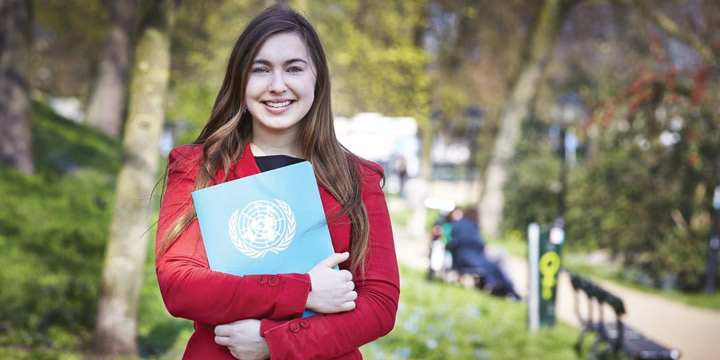




During the recent United Nations (UN) conference on climate change (COP21) last December, youth activists successfully negotiated with member states to acknowledge the importance of intergenerational equity when taking action to address climate change in the Paris Agreement.
“This is a testament to an entirely youth-driven, multi-year lobbying effort to situate the well-being of future generations as a core principle of climate policy,” Adam Hasz, member of the SustainUS youth delegation to COP21, said.
The inclusion of intergenerational participants in the Paris Agreement is one example of effective youth engagement in a UN conference. More specifically, intergenerational equity contributes to Sustainable Development Goal 13 on taking urgent action to combat climate change and its impacts.
According to the Secretary-General’s Envoy on Youth, Ahmad Alhendawi,the role of youth as partners will help determine the success of the recently adopted Sustainable Development Goals (SDGs).
“We need to engage youth as partners in development […] not to support young people as if they were a charitable thing, but we need to invest in young people because it’s a smart investment,” Alhendawi said. “We can’t achieve the SDGs if youth are considered as beneficiaries […] there are too many to cater for. They are half of the world’s population, and in some regions like in Africa, the number of young people will continue to grow over the next 40 years.”
As part of his 2015 electoral platform, prime minister Justin Trudeau included 217 promises—one of which is to create a national youth advisory council, “consisting of young Canadians aged 16 to 24 to provide non-partisan advice to the Prime Minister on issues the country is facing.”
The implementation of a national youth advisory council is one way that young people may be involved in decision-making processes on a domestic level; however, this doesn’t account for youth involvement on an international level.
In order to shift the perception of youth as beneficiaries to partners in the international sphere, young people need to play an active role in decision-making processes that affect them, alongside governments and other stakeholders. Youth can participate in decision-making processes on an international level through the United Nations Youth Delegate Programme.
The program allows young people to represent youth perspectives from their country at the UN General Assembly (UNGA) and functional commissions of the UN Economic and Social Council (UN ECOSOC) as part of their country’s official delegation.